June 17, 2026 · 8:58 AM
Burj Al Arab: How Dubai Drove 9,000 Piles Into the Seabed to Build a Sail-Shaped Hotel on a Man-Made Island
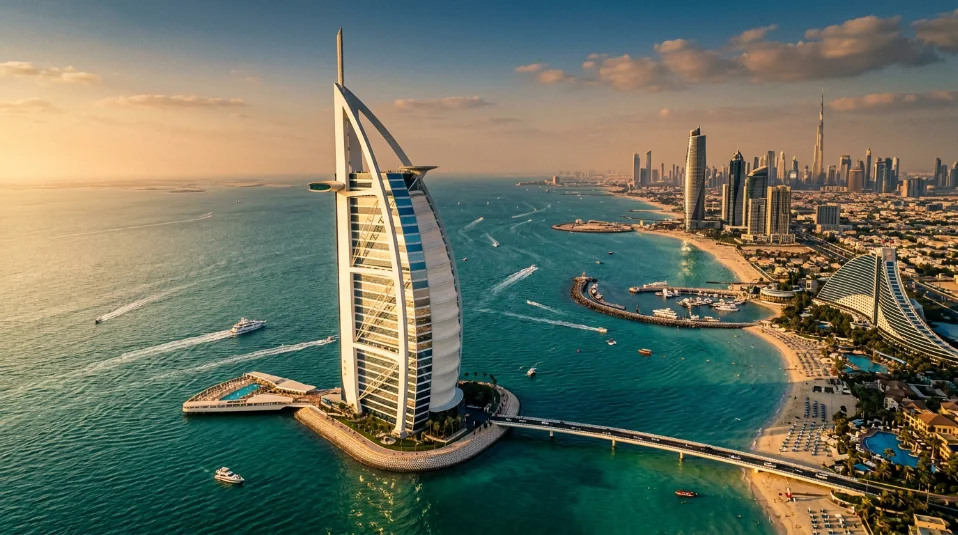
In 1994, Dubai began a three-year battle with the Arabian Sea — driving 9,000 steel piles 40 metres into the seabed to create an island that didn't exist, then raising a 321-metre Teflon-coated sail of steel and fibreglass that would become the world's most recognisable hotel.
In 1994, Dubai began building something the world had never attempted: a luxury hotel on a man-made island, 280 metres offshore in the Arabian Sea. Engineers drove 9,000 steel piles 40 metres into the seabed — a process that alone took nearly three years — before the first steel column of the tower could rise.
Designed by Tom Wright of WS Atkins, the 321-metre Burj Al Arab was engineered as a steel diagrid exoskeleton shaped like a billowing dhow sail. Its distinctive white facade is a Teflon-coated fibreglass membrane (PTFE) — one of the first large-scale deployments of the material on a building, stretched across a V-shaped cross-brace that stabilises the structure against Arabian Gulf wind loads.
Inside, the world's tallest atrium soars 180 metres. The hotel opened on 1 December 1999, instantly redefining ultra-luxury hospitality and cementing Dubai's place on the global architectural map.
Sources:
More from this channel
- CN Tower: How Canadian Engineers Poured Concrete Non-Stop for 40 Months to Build the World's Tallest Free-Standing Structure
- Guggenheim Bilbao: How Frank Gehry Used Aerospace Software to Build a Titanium Museum That Saved a City
- Brooklyn Bridge: How a Ferry Accident, Caisson Disease, and a Wire Fraud Scandal Built New York's Most Iconic Span
- Golden Gate Bridge: How 4,000 Workers Spun 80,000 Miles of Wire and Bridged San Francisco's Unbridgeable Bay
- Hoover Dam: How 21,000 Depression-Era Workers Tamed the Colorado River — With 582 Miles of Cooling Pipe and Sheer Human Grit
Related content
- Sign in to comment.