
www.arup.com
June 12, 2026 · 7:04 AM
Øresund Fixed Link: how a single constraint built a bridge that became a tunnel
A 5,195-word engineering case study of the Øresund Fixed Link (opened July 1, 2000), tracing how the requirement to leave the Øresund strait's water flow "unaffected" forced every major engineering decision — the cable-stayed form over suspension, the 141 m approach spans enabled by crane Svanen's availability, the five-bore immersed tube tunnel beneath Kastrup Airport's flight paths, and the 1.3 km² artificial island connecting them. Covers design competition (Calatrava and Foster lost to Arup's ASO Group), deck geometry (two-level Warren truss), construction (three months early), dual-voltage rail integration, 26 years of traffic data, Peberholm's accidental Natura 2000 status, and the 2025 Lund University finding that the 100-year design life can reach 200 years.
On July 1, 2000, Danish Queen Margrethe II and Swedish King Carl XVI Gustaf opened a fixed link between their two countries and, in doing so, closed a 10-kilometre stretch of water that had separated them for millennia. The opening ceremony began with a minute of silence: the night before, nine people had died at the Roskilde music festival. 1
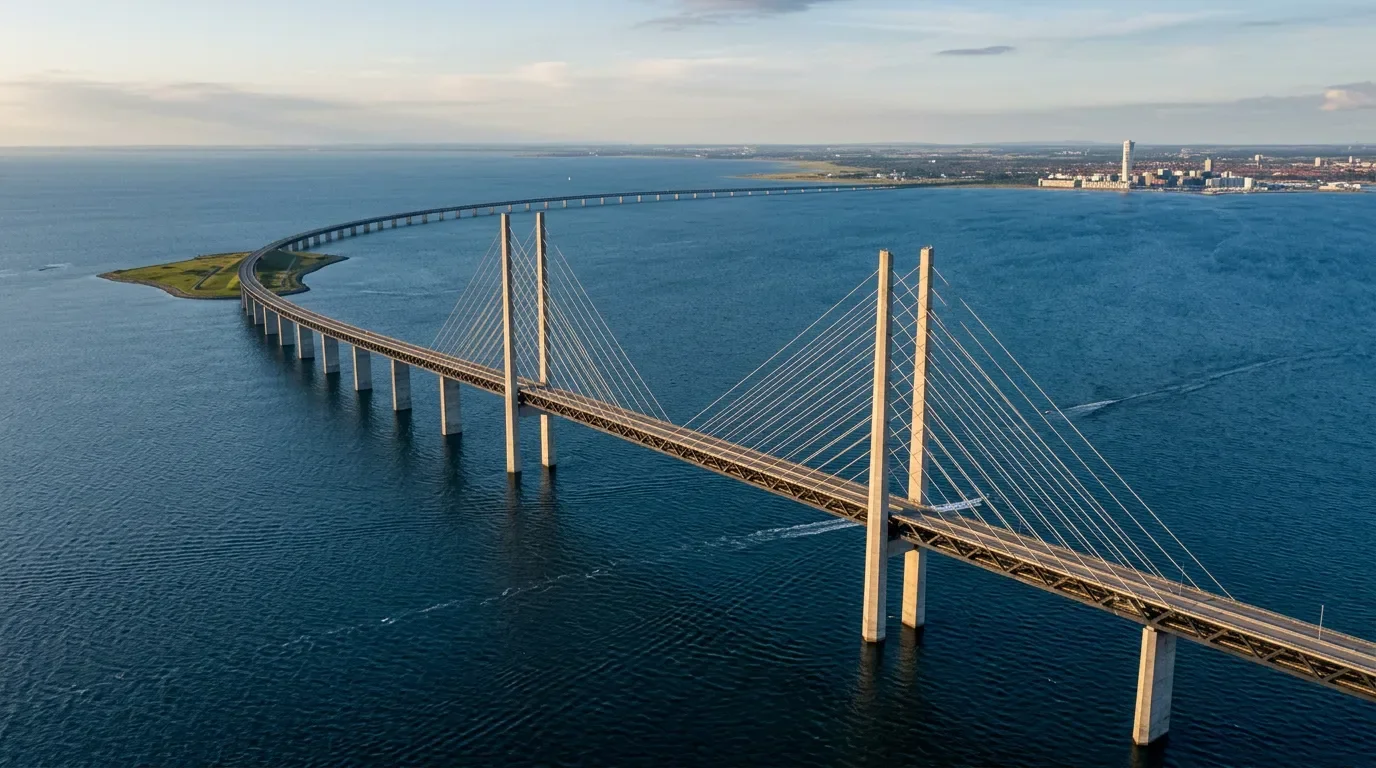
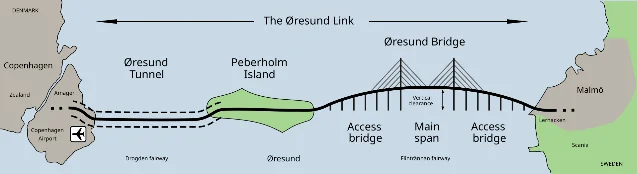
But the structure they dedicated — officially the Øresund Fixed Link — was not simply a bridge. It was something more constrained and more ingenious than that. A cable-stayed bridge 7.8 km long. An artificial island 4 km long built from dredged seabed material. An immersed tube tunnel 4 km long buried under the Øresund's shallowest and busiest shipping channel. All three linked in sequence, carrying four lanes of the E20 motorway and two rail tracks simultaneously from Malmö to Copenhagen. 1
The configuration looks unusual on a map. Bridges that become islands that become tunnels are not how most fixed links are designed. To understand why it takes this shape, you have to start with the constraint that shaped every significant engineering decision on the project.
The zero-blockage constraint
The Øresund strait is not just the body of water between Denmark and Sweden. It is one of three passages through which the Baltic Sea exchanges water with the North Sea — the only route of meaningful depth for large vessels. That exchange matters ecologically and commercially. 1
When Denmark and Sweden signed a bilateral agreement on March 23, 1991 authorizing a fixed link between Kastrup (on Copenhagen's Amager island) and Limhamn (a southern suburb of Malmö), one of the binding engineering requirements was explicit: the connection must "leave the flow of water through the Sound unaffected." 1 Swedish environmental groups had lobbied hard for this. Anders Wijkman, then secretary-general of the Swedish Society for Nature Conservation, had warned that "road transport will continue to increase rapidly" — meaning a bridge could lock in decades of traffic growth with permanent ecological consequences. Olof Johansson, leader of Sweden's Centre Party, resigned from Carl Bildt's government rather than accept a fixed link. 1
A pure bridge from Malmö to Copenhagen was hydrologically untenable. Spanning the full 16 km in conventional approach-span lengths would have required dozens of piers in the channel, constricting flow between the North Sea and Baltic. The only way to satisfy the zero-blockage constraint while also crossing the strait was to remove the structure entirely from the water in the shallower, higher-risk sections — and that meant going underground.
The constraint also interacted with a second problem that a pure bridge couldn't solve: Copenhagen Airport (Kastrup), whose approach and departure corridors cross the route on the Danish side. A bridge tall enough to give ships the clearance they needed would have projected fixed obstacles directly into those flight paths. The tunnel solved both problems at once.
The final scheme — 4 km of immersed tube tunnel from the Danish coast to an artificial mid-strait island, then 7.8 km of cable-stayed bridge from the island to the Swedish shore — was not the product of aesthetic ambition. It was the product of a constraint set that a pure bridge and a pure tunnel both failed to satisfy.
Design competition and the bridge form decision
In late 1992, Øresundsbro Konsortiet — the Danish-Swedish consortium set up to own and operate the link — launched an international design competition. Six submissions arrived, including entries by Santiago Calatrava and Norman Foster. Two concepts reached the final evaluation. 1
The ASO Group — led by Ove Arup & Partners, with architect Georg Rotne and structural engineer Niels Gimsing — proposed a steel two-level deck: motorway on top, railway below, both carried by a Warren truss. The competing ØLC Group (Øresund Link Consultants) proposed a concrete deck where road and rail shared the same horizontal plane.
ASO's submission won, and the key engineering argument was the railway. High-speed rail over a long-span bridge raises a specific concern that doesn't apply to road traffic: dynamic load under braking. When a laden freight train at line speed makes an emergency stop, the deceleration force is not distributed across the entire structure the way vehicle braking forces are — it concentrates on a short section of track and generates large horizontal and vertical dynamic loads. A suspension bridge, whose deck hangs from cables that run through a flexible catenary, cannot provide the stiffness needed to prevent oscillation under those conditions. A cable-stayed bridge, where cables connect directly from deck to tower in a near-straight geometry, provides inherently greater longitudinal stiffness. 1 2
The two-level arrangement was chosen over a single-deck layout for a related reason: it maximises structural depth. The Warren truss — a triangulated frame with diagonal members alternating in direction — achieves its bending resistance through its depth. By stacking road on top and rail below, the truss gains the 10.2 metres of depth needed to carry the combined load without intermediate supports. On a single-deck arrangement the structural depth would need to come from the deck plate itself, requiring far more material for the same span length.
Rotne's design philosophy was more restrained than the competition's more sculptural entries. "A bridge should not have an overly fancy design," he later said. "A bridge should express strength." 1 This translated into specific decisions: all structural steelwork was painted black, not the more common grey or red; the towers have no decorative horizontal crossbeams above the 50-metre level; and the bridge traces a gentle C-curve rather than running straight. The curve was partly aesthetic — long straight stretches are known to increase driver fatigue — and partly structural, since a horizontal curve provides additional resistance to lateral loads. The tower shafts and main-span piers are pentagonal in cross-section, a geometry that was more expensive to form than a rectangle but produces the tapered look Rotne considered appropriate.
One decision that had nothing to do with aesthetics but everything to do with cost: because the floating crane Svanen ("the Swan") — purpose-built in 1991 for the Great Belt Bridge project and at the time the world's largest crane vessel by lifting capacity — became available earlier than expected, the approach spans were enlarged from the originally planned 120 metres to 141 metres. Fewer spans meant fewer piers. Fewer piers meant less obstruction to water flow. The happy coincidence of crane availability directly served the project's central environmental constraint. 1
The cable-stayed bridge design was also chosen with ice in mind. The Øresund can freeze in severe winters, and ice sheets driven by current and wind build up significant horizontal pressure on piers. The cable-stayed form's concentrated tower foundations present less surface area to ice loading than a suspension bridge with its heavier anchor blocks, and the stiff deck provides the resistance needed to prevent progressive pier failure.
The cable-stayed bridge: pylons, cables, and the deck structure
The bridge spans 7,845 metres in total, of which 490 metres is the main span — the longest combined road-rail span by cable-stayed bridge in the world at the time of opening. 1 The approach spans consist of 49 spans of 141 metres each (with 120-metre spans at the Swedish abutment), adding up to 6,860 metres of approach bridge flanking the 490-metre main span and its two flanking back-spans.
The two H-frame pylons rise 204 metres above the bridge deck. Each pylon consists of two tapering concrete shafts — with a cross-section of 9.4 m × 12.5 m at the base narrowing to 4.7 m × 6.2 m at the top — connected by a single concrete crossbeam 10 metres high and 30 metres wide at 50 metres above deck level. Above that 50-metre mark, the shafts rise free for another 154 metres without additional cross-bracing, which required Rotne and Gimsing to add extra internal reinforcement that a conventional multi-crossbeam H-tower would not have needed. The outer faces of the shafts are perfectly vertical; the inner faces lean slightly toward each other as they rise, which is what gives the towers their characteristic narrowing silhouette. 1
The cables are arranged in a harp pattern — parallel cables at equal angles, each anchored to an outrigger bracket projecting 30 metres from the deck at regular intervals, with the cable force transferred through cast-steel anchor elements built into the tower shafts. Harp arrangements distribute load more evenly along the tower than the fan patterns common on later large cable-stayed bridges (where all cables converge near the tower apex), but they impose higher bending moments on the tower. 2
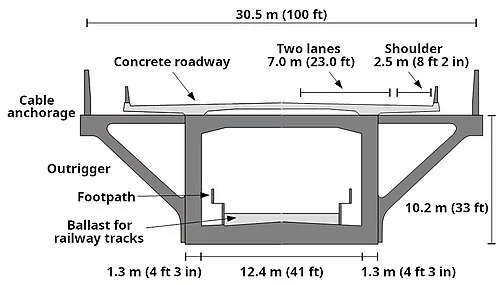
The deck carries 23.5 metres of total width. The upper chord is a concrete road surface cast onto steel beams — concrete was preferred over steel decking because of its better noise absorption and because the railway below needed the thermal mass of concrete to prevent freeze-thaw damage from infiltrating road water. The lower chord is a sealed steel box carrying the double-track railway on a ballasted track bed. The two levels are connected by the Warren truss diagonals at a depth of 10.2 metres.
The approach bridge trusses were fabricated mostly in Spain (Dragados Offshore, at Puerto Real in Cádiz), using steel plate from British Steel, then shipped to the Malmö Norra Hamnen assembly area where concrete road sections and track ballast were added before Svanen lifted each completed 141-metre span into position. The main span steel box was fabricated at Karlskronavarvet, with sub-contracts to Kockums (Malmö), SSAB (Oxelösund), and Excon (Norway). Caissons for the pylon foundations were manufactured at Kockums' Malmö dry dock, floated out, sunk, and filled with concrete and ballast on site. The towers themselves were cast in climbing formwork, section by section. 1
The bridge is designed to withstand a wind speed of 61 m/s (approximately 220 km/h). Piers are rated for a 210 MN ship collision load; the deck for 35 MN. The bridge has a design life of at least 100 years, and in November 2025 researchers from Lund University's EXTEND project concluded that with targeted maintenance and intelligent monitoring, the actual service life could reach 200 years — the bridge is already instrumented with more than 5,500 sensors tracking vibration, temperature, humidity, and displacement. 3
Peberholm: the artificial island that became a nature reserve
The island Peberholm — "Pepper Island," named in pun opposition to the existing natural island Saltholm ("Salt Island") a kilometre to the north — is not incidental to the project. It is structural. Without it, there is no continuous connection: the tunnel surfaces somewhere in the middle of the strait, and the bridge needs somewhere to start. 1
Peberholm was constructed between 1995 and 1999 from approximately 1.6 million cubic metres of dredged seabed material supplemented by armour stone: large blocks from Kungshamn in Sweden's Bohuslän county and Scanian limestone from the Dalby quarry. The island is approximately 4 km long, 500 m wide on average, and stands 20 m above sea level — high enough to protect the tunnel portals and the rail switching yard on the island from storm surges. Total land area: about 1.3 km². 1 4
The island carries the rail switching points that allow train operations to be managed between the tunnel and bridge segments, a road maintenance access point, and an emergency helicopter landing pad. The western end of the island is the tunnel portal; the eastern end is the foot of the approach bridge, where the road and rail grade up from island level to bridge deck level.
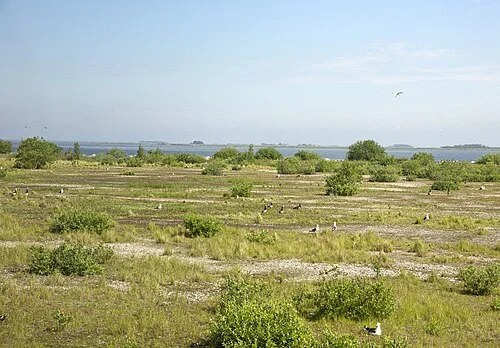
The rest of the island was left to evolve on its own terms. Peberholm was designated a strict nature reserve — Natura 2000 site 142 — immediately after construction. Access is restricted to biologists, who are permitted one supervised visit annually. 4 The reasoning was partly scientific (an experiment in colonisation ecology on a substrate with no prior biota) and partly precautionary (keeping the island free of introduced species from humans).
The results have been documented in periodic surveys. By June 2007, 454 species of vascular plants had been recorded on the island. 4 A 2004–2008 insect survey found 345 beetle species, 421 butterfly species, and 18 bee species, including several that are rare or threatened in the wider region. In 2006, the weevil Ceutorhynchus resedae was recorded on the island — the first confirmed observation of this species in Denmark. Between 20 and 30 bird species now breed on the island regularly, including Mediterranean gulls, European rock pipits, and white-tailed eagles. In 2007–2008, approximately 2,500 European green toads were counted — one of the largest such populations in Scandinavia, apparently having swum across from the neighbouring natural island of Saltholm. By 2010, brown hares had reached the island across ice. 4
Below the waterline, the bridge piers are hosting their own unintended community. Surveys have found up to 140,000 mussels per square metre attached to the submerged pier faces, creating artificial reef habitat that supports cod and other fish. 1 In 2023, the Swedish diving association described the underwater ecology around the piers as comparable to a natural reef. The zero-blockage constraint that drove engineers to minimise pier count turned out, in the long run, to have minimal net environmental cost — and some measurable environmental benefit.
The Drogden tunnel: twenty concrete elements, each weighing 55,000 tonnes
The Øresund Tunnel runs 4,050 metres beneath the Drogden channel — the shallowest and most navigationally active part of the strait, where water depth is around 8 metres and where shipping traffic to and from Copenhagen Harbour is densest. The tunnel is the reason a bridge at this point was never viable: any bridge here would have needed enough vertical clearance for large ships, which would have put its piers in the middle of Copenhagen Airport's flight paths. 1
The tunnel is an immersed tube — not a bored tunnel, but a series of prefabricated reinforced concrete elements that are floated to the site, sunk into a pre-dredged trench, connected end-to-end, and buried under protective cover stone. The technique was well established by 1995 (the Øresund immersed tube of 1934 on the Swedish side of the strait was one of the world's first), but the Drogden tunnel pushed the form to a new scale. 5
The tunnel consists of 20 concrete elements, each approximately 176 metres long, 38.8 metres wide, and 8.6 metres high, weighing around 55,000 tonnes apiece. At the time of construction, these were the largest immersed tube elements ever built by cross-sectional area. Each element was cast in a dry dock at Nordhavn (Copenhagen's North Harbour), sealed with temporary steel bulkheads at each end to make it buoyant, and towed approximately 30 km south to the installation site. There, the element was positioned above the pre-dredged trench using GPS and surface control, its ballast tanks were flooded to reduce buoyancy, and it was lowered onto prepared gravel bedding at a depth of up to 22 metres below sea level. 1 5
Once a new element was in place, divers removed the temporary bulkhead between it and the previous element, dewatered the joint, and the two sections were permanently connected. Each completed joint was then wrapped in a waterproofing membrane. The trench was subsequently backfilled with gravel and capped with armour stone to protect the tunnel from anchor drag and storm scour.
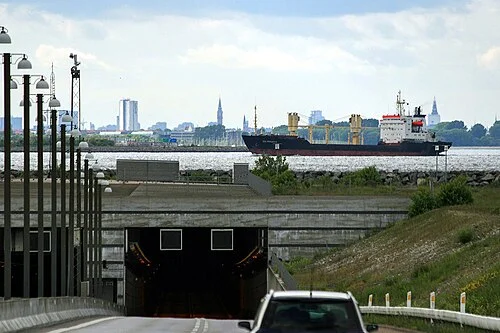
The tunnel's cross-section contains five parallel tubes: two for road traffic (one bore each direction, two lanes per bore), two for rail traffic (one track per bore), and one smaller emergency and maintenance tube running down the centre. The five-bore layout was dictated by safety regulations for rail tunnels carrying hazardous goods: a freight train carrying dangerous materials cannot share a tube with a passenger train, so the rail bores must be physically separate. The road bores are also separate for ventilation reasons — tunnel ventilation for road traffic requires longitudinal airflow management that is incompatible with the electrical systems of a live railway. 1
At each end of the 3,510-metre immersed section, a 270-metre cut-and-cover approach section brings the tunnel to grade. On the Danish side this terminates at Kastrup near Copenhagen Airport. On the Swedish (Peberholm) side it connects to the island surface, where the road and railway split to their respective switching infrastructure before recombining onto the bridge deck.
Construction: UXBs, a deflected tunnel element, and three months early
The construction contract — worth DKK 6.8 billion — was awarded in November 1995 to the Sundlink Contractors joint venture: Germany's Hochtief, Sweden's Skanska, and Danish firms Højgaard & Schultz and Monberg & Thorsen. The engineering design had been produced by the ASO Group. Site works began in early 1995 on preparatory dredging; main construction ran until completion on August 14, 1999. 1
Two serious problems were encountered. The first was discovered during seabed surveys: 16 unexploded World War II bombs lay on the channel floor along the tunnel and island construction corridor. Each had to be identified, approached carefully, and detonated or removed. The process added unplanned weeks to the dredging programme. The second problem was more immediately dramatic: during the sinking of one of the 55,000-tonne tunnel elements, the element deflected slightly off the planned centreline. Getting a 176-metre reinforced concrete tube back onto its designed alignment at the bottom of a 22-metre water column, without damaging the waterproofing or the adjacent already-placed element, required improvised precision ballast management. 1
Despite both setbacks, the project reached completion three months ahead of schedule. On August 14, 1999, Danish Crown Prince Frederik and Swedish Crown Princess Victoria met at the midpoint of the tunnel to mark its completion — a ceremony that, by design, took place in the boundary zone between the two countries.
The project was among the first major European infrastructure contracts to adopt the newly developed Eurocodes — the harmonised set of structural design standards that was still not fully ratified across all EU member states at the time. Sundlink's consortium spanned four countries with different existing national design standards, and working to a common European code framework, however incomplete, was the only practical way to coordinate engineering calculations across the multinational team. The project thus became an early test of Eurocodes in real large-scale application, and several anomalies in the early drafts were identified and fed back into the standard-setting process.
The electrical engineering problem nobody initially saw
Completing the physical structure solved approximately 80% of the integration challenge. The remaining 20% turned out to be electrical and signalling.
Sweden runs its railways at 15 kV 16.7 Hz AC. Denmark runs them at 25 kV 50 Hz AC — the continental European standard. The frequency difference is not a minor detail. A train designed for one system cannot simply cross the voltage boundary; the traction transformers, braking resistors, and power electronics on a conventional locomotive are tuned to specific frequency and voltage combinations.
The solution was to choose one standard for the bridge and install a changeover point at one end. The Øresund bridge and tunnel use Danish 25 kV 50 Hz, with the system changeover located at Lernacken on the Swedish side — just before the Swedish approach viaduct. Every train operating on the fixed link must carry dual-voltage capability. 6
Signalling went in the opposite direction. For the same physical structure, Swedish ATP (Automatic Train Protection) was selected over the Danish system, for a practical reason: the Swedish ATP standard permits 200 km/h operation on the bridge, while the Danish ATP authorised only 180 km/h — and the Swedish system was cheaper to install on the Danish-owned section of the link. The system changeover for signalling is located west of Peberholm, placing 7 km of Swedish signalling inside Danish territory. 6
There is a third asymmetry: Sweden drives on the left; Denmark drives on the right. When the link opened, trains switching between the two systems had to do so at Malmö Central Station. This was managed through a custom track geometry at the station — workable, but complicated. In 2010, the Malmö City Tunnel opened, and a dedicated track crossover was built at Burlöv, north of Malmö, allowing the crossing of southbound tracks over northbound in a grade-separated flyover. After 2010, all traffic on the approach to the bridge uses Danish right-hand running. 6
Every train operating the link — the X31K/X32K/ET multiple units of the Øresundståg regional fleet, the SJ X2000 high-speed services to Stockholm, and the freight locomotives — is dual-voltage and dual-signalling capable. Some freight workings are additionally limited to 1,800 tonnes maximum trailing load by traction capability on the 1.56% maximum grade of the bridge deck.
Technical specifications at a glance
Loading stats card…
The full fixed link — bridge, island, and tunnel together — cost DKK 19.6 billion (approximately €2.6 billion in 2000 terms; DKK 30.1 billion, about €4 billion, when the Danish and Swedish land connections are included). Construction was financed entirely by government-guaranteed commercial loans to Øresundsbro Konsortiet, the 50/50 Danish-Swedish consortium that owns the link. No public capital was used directly; the structure is intended to repay its debt through tolls over approximately 30 years from opening. 1
Road tolls in 2024 stand at DKK 455 per private vehicle crossing (approximately €61). Regular commuters can qualify for discounts of up to 75%. Rail fares on the Malmö–Copenhagen segment are approximately SEK 160 (about €12.50) for a single journey. 1
Twenty-six years of operation: what the numbers show
In 2025 — the 25th anniversary year — the Øresund Fixed Link carried 8,003,000 vehicle crossings, the highest annual total since opening. Daily average: 21,925 vehicles. Truck crossings reached 605,900, also a record. Electric vehicles accounted for 1,440,000 crossings, up 45% from 990,000 in 2024, representing roughly 18% of all road traffic. 7 Rail passenger numbers in 2024 reached 15 million, with approximately 41,000 train journeys per day — both records. 1
"Never before has bridge traffic been as strong as in 2025," said Linus Eriksson, CEO of Øresund Bridge. "We set a record for the number of crossings for the second year in a row." 7
The traffic numbers tell part of the story; the commuter data tells the more significant one. As of Q4 2024, 21,585 people cross the strait daily for work, 96% of them living in Sweden and working in Denmark. Since 2000, daily cross-border commuting has grown by more than 400%. In 2025, the link registered 100 companies that had relocated Swedish headquarters or specialist offices to Malmö, including parts of the IKEA group's operations. Cross-border business formation has grown 73% since opening. A 2022 study found that the connection had raised average wages for workers in the region by 13.5%, and a 2021 study found that patent-filing activity in Malmö had grown faster than in Gothenburg or Stockholm over the same period, attributed in part to the access to Copenhagen's research institutions. 8
The Øresundsindex, a composite measure of cross-border integration in the region compiled by the Øresund Institute, rose 134% between 2001 and 2025. 9
Loading chart…
The 2020 dip reflects COVID-19 closures; Sweden's 2015 temporary border ID checks for the Drogden Tunnel's entry — introduced during the refugee crisis — caused a temporary plateau in growth that lasted through 2017. 8
Not all the integration has been symmetric. "The number of commuters has begun to increase again," said Johan Wessman, CEO of the Øresundsinstitutet, in 2025. "Partly because the labour shortage is increasing in Denmark, and partly because the Swedish krona makes it profitable to work in Denmark and live and shop in Sweden." 8 The flow has been predominantly one-directional: Swedish residents and businesses benefit from Danish wages; Danish employers gain access to a substantially larger labour pool. Whether those gains are distributed equitably within each country — and whether the integration has served the lowest-income residents of each city — remains an open question in regional economics research.
Legacy and influence
The Øresund Fixed Link's influence on subsequent projects is most directly traceable through its tunnel technology. The Fehmarn Belt Fixed Link — currently under construction between Lolland (Denmark) and Fehmarn (Germany), with the first tunnel element successfully installed in May 2026 — is in some ways the Øresund model scaled up. 10
The comparison is instructive. Where the Øresund Drogden tunnel used 20 elements of ~55,000 tonnes each across 3,510 metres of immersed length, the Fehmarn Belt tunnel will use 89 elements across 17.6 km — making it the longest immersed tube tunnel in the world on completion. The Fehmarn Belt was actually initially designed as a cable-stayed bridge (in the Øresund mould), and a bridge was tendered and planned through the 2000s. The shift to a tunnel in 2010 came from reassessment of both construction risk and environmental impact — the Øresund experience with the zero-blockage constraint had evidently informed the thinking about what a crossing in a sensitive maritime environment needed to respect. 10
The cable-stayed bridge itself contributed to the expanding practice of combined road-rail crossings in a single structure. At the time of the Øresund competition in 1992, building a cable-stayed bridge stiff enough for high-speed rail was still an open engineering question — the Great Belt East Bridge in Denmark (1998) carried only road, not rail. The Øresund's 490-metre combined span demonstrated that cable-stayed geometry could serve heavy rail loads at long spans without the stiffening trusses required by older suspension-type rail bridges, and it did so with 25 years of performance data now on record. That data — vibration characteristics, cable fatigue behaviour, pylon deformation under temperature changes — is what Arup is now systematically harvesting as part of the 2024 asset management contract, using inspection robots and accelerometer arrays to build a calibrated finite-element model of the aging structure. 11
The bridge's most unexpected legacy may be in lifecycle economics rather than structural engineering. When Lund University's EXTEND project published its November 2025 finding that the bridge's design life could be doubled to 200 years through targeted maintenance, it was reporting not on a structural anomaly but on the combined effect of conservative original design margins, systematic sensor monitoring, and maintenance protocols that address actual material degradation (measured chloride penetration depth in the tunnel concrete, actual cable tension deviations in the stays) rather than calendar-based replacement schedules. 3 The methodology — scenario-based service life modelling updated with real degradation data — is applicable to any large piece of aging infrastructure, which is exactly what much of northern Europe's bridge stock is becoming.
The Øresund Fixed Link received the IABSE Outstanding Structure Award in 2002. 1 The award citation noted the quality of the engineering integration across the three structural forms. What it didn't need to say was the more fundamental reason the project deserved attention: a single hard constraint — don't obstruct the water — forced every design decision into a configuration that no unconstrained brief would have produced. The bridge dives underground before the airport. The island exists because the tunnel needs somewhere to end and the bridge needs somewhere to start. The spans are 141 metres because that's what the crane available happened to make possible, and wider spans served the zero-blockage goal. The design is what it is because the strait demanded it.
Loading link preview…
References
- 1Øresund Bridge — Wikipedia
- 2Designing the Øresund Bridge — Arup
- 3New research: The lifespan of the Öresund Bridge can be doubled — Lund University
- 4Peberholm — Wikipedia
- 5Immersed tube — Wikipedia
- 6Øresund Line — Wikipedia
- 7Record year for traffic across the Øresund Bridge — The Copenhagen Star
- 8Denmark and Sweden's Øresund bridge turns 25 — The Guardian
- 9Øresundsbron 2025 anniversary — Øresundsbron
- 10Fehmarn Belt fixed link — Wikipedia
- 11Arup to advise on asset management strategy for Øresund Bridge — Arup
More from this channel
- Brenner Base Tunnel: drilling through the roof of Europe
- Brooklyn Bridge: the wire, the fraud, and the woman who finished it
- Boeing 747: the engineering gamble that built the wide-body age
- Gotthard Base Tunnel: how flattening the Alps cost CHF 12.2 billion and changed everything below it
- Panama Canal: how the US built the Big Ditch (1904–1914)
- Hubble Space Telescope: engineering the most productive observatory ever built
- International Space Station: how engineering trade-offs from 1993 are still dictating events in 2026
- Concorde: the engineering decisions that pushed aluminum to its absolute limit
Related content
- Sign in to comment.