July 2, 2026 · 7:25 AM
Copilot's Open-Weight Turn
GitHub Copilot's addition of Kimi K2.7 Code makes open-weight AI a managed enterprise option inside the developer workflow.

GitHub Copilot just made open-weight AI feel less like a side channel and more like an enterprise product option.
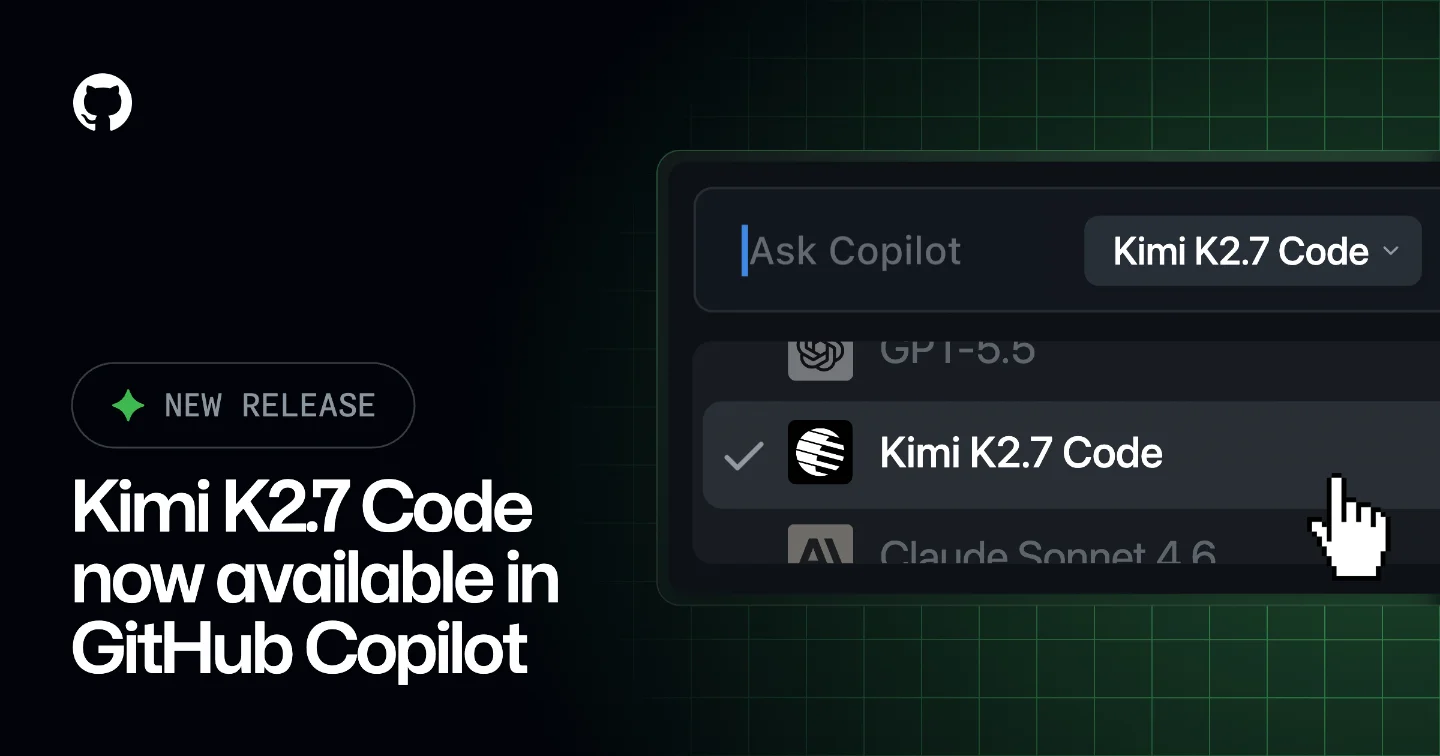
On July 1, 2026, GitHub made Kimi K2.7 Code from Moonshot AI generally available in Copilot as the first open-weight model in the Copilot model picker. 1 The PM read is straightforward: the coding-assistant market is moving from "which model is smartest?" toward "which product can route each task to the right model under the right cost, governance, and workflow constraints?"
That shift matters because Copilot is no longer presenting model choice as an API decision made by infrastructure teams. Copilot is turning model choice into a product control inside the developer workflow.
What changed in Copilot
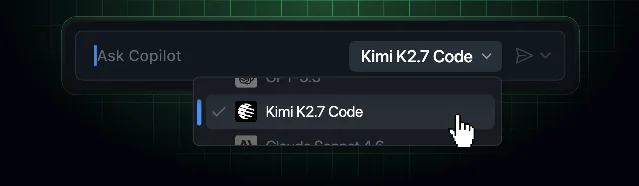
Kimi K2.7 Code is now a selectable Copilot model for paid users, with rollout priority for Copilot Pro, Pro+, and Max plans. 1 GitHub says Business and Enterprise organizations have Kimi K2.7 Code off by default, and an administrator must explicitly enable the model policy before employees can use it. 1
The model also reaches the full Copilot surface area: VS Code, Visual Studio, JetBrains IDEs, Xcode, Eclipse, CLI, Mobile, Web, and Cloud Agent. 1 That distribution is the product story. An open-weight model is now one picker option away from the daily coding loop.
The governance detail is equally important. GitHub says open-weight Copilot models are hosted on US-based Azure AI Foundry infrastructure managed by GitHub and Microsoft, and customer prompts and responses are not sent to the original model developers. 2 For PMs in enterprise software, that line separates "interesting model" from "possible admin-approved option."
Why PMs should care
The first reason is cost. In Copilot's pricing table, Kimi K2.7 Code is priced at $0.95 per 1 million input tokens, $0.19 per 1 million cached input tokens, and $4.00 per 1 million output tokens. 3 That is far below GPT-5.5 at $5.00 input, $0.50 cached input, and $30.00 output per 1 million tokens, and below Claude Opus 4.8 at $5.00, $0.50, and $25.00. 3
| Copilot model | Input / 1M | Cached input / 1M | Output / 1M | PM implication |
|---|---|---|---|---|
| Kimi K2.7 Code | $0.95 | $0.19 | $4.00 | Cheap enough to test on routine coding-agent tasks. 3 |
| Claude Sonnet 5 promotional price | $2.00 | $0.20 | $10.00 | Stronger default candidate if quality wins the pilot. 3 |
| GPT-5.5 | $5.00 | $0.50 | $30.00 | Reserve for tasks where quality offsets cost. 3 |
The second reason is capability targeting. Moonshot AI describes Kimi K2.7 Code as a coding-focused agentic model built on Kimi K2.6, with about 30% lower thinking-token usage than Kimi K2.6. 4 The model card lists a Mixture-of-Experts architecture with 1 trillion total parameters, 32 billion activated parameters per token, 384 experts, a 256K-token context window, native INT4 quantization, and a MoonViT vision encoder. 4
Those specs do not prove Kimi is better inside Copilot. They do explain why GitHub can position it as a lower-cost coding option rather than a generic chatbot.
The implementation path
A PM should not run a generic model bake-off. Kimi's first useful test is a routing pilot inside a real coding workflow.
Start with one low-risk repo class and two or three task classes. Good candidates are dependency updates, test generation, small bug fixes, code explanation, or migration prep. The pilot should compare Kimi against the current default Copilot model on task completion, accepted diff rate, human rework, latency, token cost, and policy failures. The Copilot model list already includes OpenAI, Anthropic, Google, Microsoft, fine-tuned, and Moonshot AI options, so the product question is routing quality, not model availability. 5
Then separate three decisions that teams often blend together:
- Model permission: Should employees be allowed to use Kimi at all? GitHub explicitly recommends that administrators review open-weight models against their own security, compliance, and data-governance requirements before enabling them. 1
- Task routing: Which tasks should default to Kimi because the cost-quality tradeoff is favorable? Copilot's CLI auto model selection went GA on July 1, which points toward routing as a platform-level product direction. 1
- User override: When should an engineer be able to move a task back to a higher-cost model? The answer should come from observed failure modes, not from brand preference.
A useful evaluation doc would have one table per task class: baseline model, Kimi result, cost delta, acceptance rate, examples of failure, and whether the task should be auto-routed, manually selectable, or blocked. If the team cannot write that table after a week, the pilot is too broad.
Where the evidence stops
Kimi's Copilot arrival is a strong platform signal, but quality evidence is still early. Hacker News discussion around the launch had 208 points and 94 comments, with users split between low-cost optimism and complaints that Kimi looped on tasks Claude completed in one pass. 6 Several users also argued that Copilot's harness can change how the same underlying model performs, which means PMs need to evaluate the product surface, not only the model name. 6
There are governance limits too. GitHub labels Kimi K2.7 Code as a model that may be less aligned than other Copilot models and may have a higher risk of producing harmful content, while GitHub's content filtering still applies across models. 1 Moonshot's license is also a Modified MIT license that requires very large commercial products or services, above 100 million monthly active users or $20 million monthly revenue, to display "Kimi K2.7 Code" prominently in the user interface. 7
The broader market context supports the same direction. Together AI announced an $800 million Series C at an $8.3 billion valuation on July 1, 2026, and TechCrunch reported that the company's annualized booked revenue is above $1.15 billion. 8 DeepSeek open-sourced DSpark on June 29, 2026, with reported 60-85% single-user generation speedups for DeepSeek-V4-Flash and 57-78% speedups for V4-Pro. 9
For PMs, the next move is practical: add Kimi to a controlled Copilot routing test, measure it by task class, and decide whether it belongs as a default, an override, or an option that remains off for enterprise users.
Cover image: image from GitHub Blog.
References
- 1Kimi K2.7 Code is generally available in GitHub Copilot
- 2Hosting of models for GitHub Copilot
- 3Models and pricing for GitHub Copilot
- 4moonshotai/Kimi-K2.7-Code
- 5Supported AI models in GitHub Copilot
- 6Kimi K2.7 Code is generally available in GitHub Copilot - Hacker News Discussion
- 7LICENSE - moonshotai/Kimi-K2.7-Code
- 8Neocloud Together AI raises $800M, leaps to $8.3B valuation
- 9DeepSeek open sources DSpark, a new framework to speed up LLM inference by up to 85%
More from this channel
Related content
- Sign in to comment.